Trust the Process

Ever feel like its impossible to just trust the process? Horses are complicated creatures, and progress is never linear. So how do we keep the motivation up on days where we feel like we’re teaching them how to trot from scratch, or when we cannot for the life of us leave all the poles up?

Learning to love the process is, in my opinion, the most essential skill for good horsemanship. We put so much pressure on the end result, expecting a masterpiece while we’re stuck using MS Paint. In this post, we will explore what it means to fall back in love with the good, the bad, and the ugly that is an inevitable part of achieving your goal.

Goal Setting

It’s all too easy to get caught up in the ‘big dream’, whether that be the Olympics, Badminton Grassroots, or even jumping your biggest jump yet. However, what this mindset fails to acknowledge is the tens or hundreds of hours you spend learning and teaching along the way. The horse world is full of setbacks (ie. horses that make it their life’s mission to accrue eye-watering vet bills), so learning to find joy in the smaller things can make even the hardest days feel just a little bit less sour.

Make Goals Achievable

Ask yourself – what are the steps that will get me to where I need to go? For instance, if your goal is to jump your biggest jump, your steps might look like: 
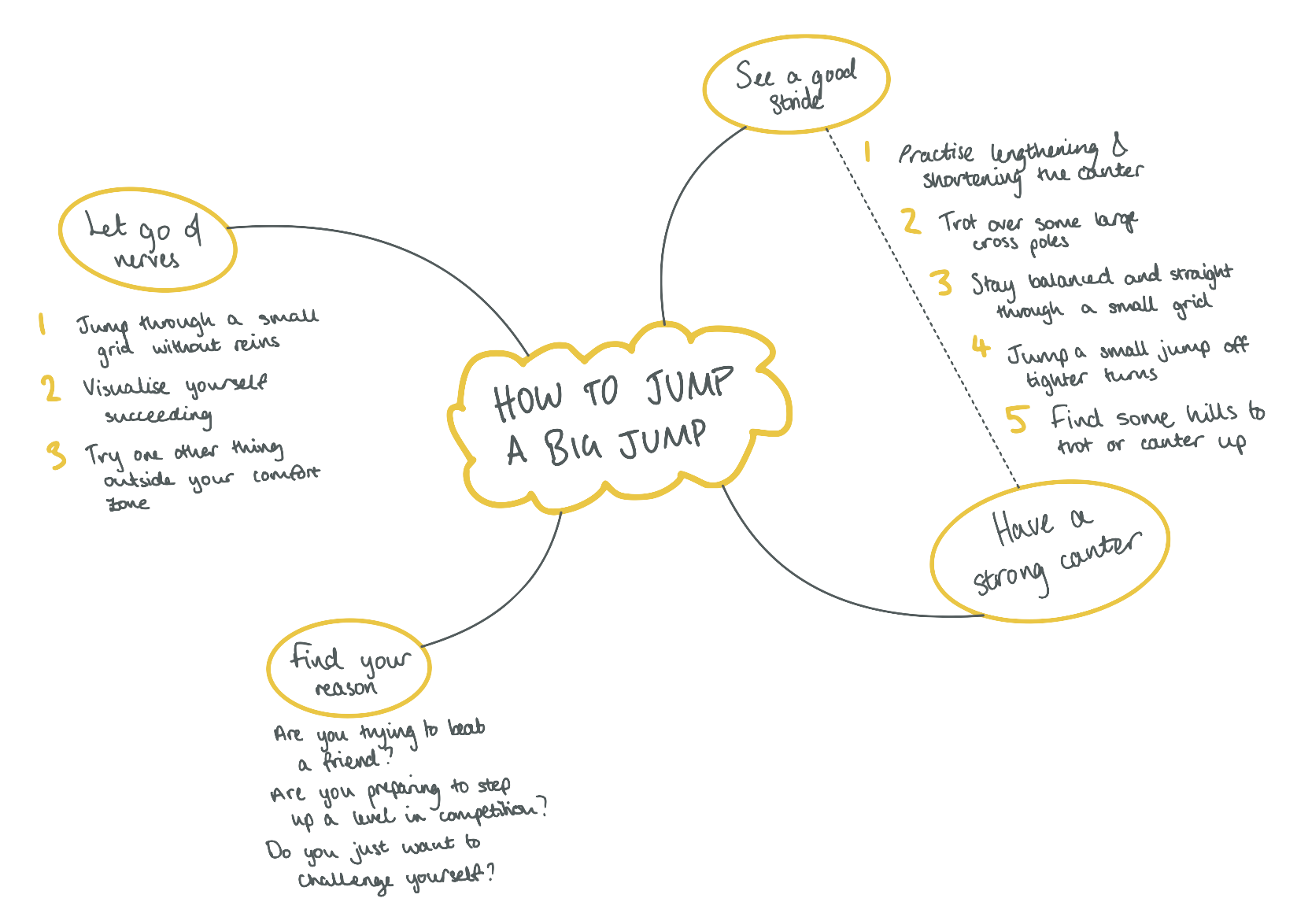
Once your big goal is broken down into clear, achievable steps, you’ll be ticking something off your list every day and feeling great about it. Each little bit of progress will become something to celebrate, and you’ll find your motivation skyrocketing each day as you find yourself and your horse improving with each ride.

Quit While You’re Ahead

Whether you’re a goal-setter or a play-it-by-ear person, an incredibly valuable trait to have is the ability to appreciate every small improvement. We’ve all heard it a hundred times – quality over quantity – and it really is true when it comes to training horses. When I’ve been schooling up horses, whether its weak youngsters or stiff older horses, I make it a rule to get off when they get it right. For instance, when I know I’m riding a horse who particularly struggles to find connection in canter, I’ll warm up and then spend a few minutes asking for a nice canter with a bit more bend and balance. Then, as soon as they offer me a nice stride or two, I drop my reins, walk around for a bit, and then get straight off. That way, this session has achieved two things: taught the horse the desired cue and response for a ‘nice’ canter, and learnt that hard work and correct answers earns a clear reward. Then the next session, even if it’s a whole week later, the horse will achieve this canter quicker, and for several more strides than before.

Sometimes this mindset will mean that you’re ‘quitting’ after only 5 or 10 minutes – and that’s fine! If your horse needs to keep moving for whatever reason, you can still change it up – walk over some poles, go for a short hack, or do some work in hand – but just be sure to take the pressure right off after your horse has correctly answered whatever challenging question you’ve been asking. Sometimes it’s tempting to try it just one more time, or just jump a little bigger, but remember, if this is has been a big ask for your horse, or a new skill, then it will have required a lot of both mental and physical energy, so sometimes trying again will result in a fatigued, frustrated horse not being able to give you what you’re asking for twice or thrice in a row. In rewarding even the smallest efforts, you will nurture a motivated horse with a great work ethic who wants to try their best for you.

Embrace the Setbacks

If you’re progressing, you’re going to have setbacks. That’s just part of the deal. I’m sure you’ve heard the phrase you have to crack the eggs to make the omelette, and if you haven’t, it sure is one to live by. In essence, things often get messy before they come together. For example, every time my OTTB makes a breakthrough with his trot work, our canter transitions fall apart a little while he adjusts to a new way of carrying himself and using his body through the transition. It can be frustrating, but each and every setback can be a learning opportunity if approached properly.

Next time you’re finding yourself struggling with a small setback, ask yourself why you might be experiencing it. Maybe your horse has started tapping the odd pole because his newly-improved jumping technique is harder work than before when he relied on momentum, or maybe you’re now struggling to keep your horse in an outline because he’s actually lifting his back and using his back end, and just needs a little time to adjust to this new correct way of going. Whatever it may be, just cut yourself some slack, appreciate the fab work you and your horse have been doing, and then re-approach your goal-setting with a fresh mindset.

Trust the Process

A mantra to live by. Include it in your daily affirmations. Get it tattooed on your forehead. Whatever it takes. Just remember that when things aren’t moving as quickly as you’d like, learning to love the process is the best thing you can do for both you and your horse’s progress. It makes every day feel just a bit more satisfying – even the ones where everything goes a bit wrong.

What to do When You Hit a Wall

You ever feel like you’ve been riding the same ride, day in, day out, and nothing’s changing? Nothing’s going wrong – hey, things are actually going pretty well overall – but you just feel… stuck.

Don’t worry, we’ve all been there.

1. Don’t panic

Take a step back for a minute. Take some deep breaths and give your horse a pat, or get off and save him for another day. Unless you’re on your way to Badminton next year, you can chill out. Take a minute to appreciate the things that are going well and the things that you enjoy, even if it’s just the extra 5 minutes you took to groom your horse earlier, or the fact that he only spooked at his own shadow twice today. One time my OTTB decided that simple turns on the forehand were rear-inducing, so I got off him and made sure he had them nailed down in hand. Spoiler alert – he didn’t.

2. Make a plan

Have a think about why you feel stuck. Is your routine lacking variation? Are your half passes not clicking despite working on them for weeks? Or is something just not quite right? Knowing the answers to these questions will be your greatest ally when it comes to tackling this mental stagnation.

Once you’ve spent a bit of time sitting with your thoughts (terrifying, I know), write them down in a problem-solution format. For example, if your problem is a lack of variation, your solution could be to ride a different hacking route, or go to a pole clinic, or even ride in your horse’s field bareback if other options aren’t accessible to you. If your problem is your half passes (although when are they not a problem?), then solutions could include having a lesson, practising them on hacks, or going back to basics and solidifying more basic lateral movements such as turns on the forehand and leg yields. Once you’ve made your plan and can tick off steps as you go, the situation suddenly looks more manageable.

Don’t fall into the trap of overcomplicating your plan – you don’t need to plan every step, or be looking months or years into the future – just a few small, easily achievable changes to make so that you can tick something off and feel like you’ve accomplished something. I, for some reason, have a tendency to buy cheap, feral youngsters online, and sometimes the plan can be as simple as 1) touch the horse without getting bitten, 2) get a head collar on it, 3) walk it around the arena without dying. Seriously, you’re doing great. Baby steps.

3. Take the pressure off

Sometimes all you need is to stop taking it so seriously – we’re supposed to be enjoying these stupid creatures, aren’t we? Go gallop up a field. Ride to a pub with a mate. I don’t care – just do something novel, and bring some enjoyment back into this bottomless money pit that we call a sport. An easy way to do this can be to switch disciplines for a day – so dressage riders can shorten their stirrups and hop over a cross pole, and the show jumpers can swing their legs around in too-long stirrups and perfect their lateral work (and lets face it, you’ve been putting this off for months already, haven’t you?). You eventers are greedy aren’t you – hogging all the disciplines – so maybe you could put your reins in one hand and try neck reining? Or finally jump some of those hedges that you’ve been eyeing up on your hacks? You know you want to – just don’t take it too far. I thought that trying to jump my mum’s cob with no reins or stirrups was a genius idea until I found myself rather unceremoniously thrown into a fence. Know your limits I guess.

We put too much pressure on ourselves – and that’s a good thing when its driving passion and progress, but sometimes we just need to chill out a bit. Once we let go of that nagging feeling that we should always be doing something quicker, better, or just different, motivation often finds us again when we’re least expecting it.

I think the only thing left to say at this point is just be kind to yourself. We all feel like we’ve hit a wall at times, and that’s okay. Take a deep breath, make a plan, and enjoy yourself. The rest will sort itself out.

Unpopular Opinion: Most Riders Rely Too Strongly on Gadgets

You walk into any yard, and you’ll see it – martingales as standard, draw reins lying around, and the legendary ‘bit box’, a 20 year-old collection of weird and wonderful contraptions that you’re not quite sure which way up they’re supposed to go. But the question is, are we as riders becoming too reliant on these gadgets?

If you ask me, the answer is yes. 

We live in an age of instant gratification, where Reels, TikTok, and ChatGPT give us quick answers and even quicker dopamine hits. Unfortunately, it is human nature to fall victim to this mindset, where a ‘quick fix’ is preferable to good old-fashioned blood, sweat and tears. But has the horse world taken this too far?

Unfortunately, the desire for instant results often comes at the expense of our horses. How many times have you been told to put a martingale on your horse who throws its head in the air? To put a stronger bit on the one that bolts? Or to put draw reins on a horse that’s fussy in its contact? Far too many people will land on one of these conclusions because it’s easier and quicker than addressing the root cause of the problem.

The issue with running martingales is their mechanism. Sure, they make a horse carry its head in a ‘prettier’ way – and who wants a black eye half way round a course of jumps? But did you ever ask yourself why your horse is throwing its head into a position that is surely uncomfortable for itself? These are symptoms, not the cause. Often a horse will throw its head up to evade some form of discomfort. It’s a common symptom of kissing spine, bitting or contact issues, or can even be as simple as a method for a horse to see the jump better. In the latter case, pay attention to whether this only occurs in front of a jump, as horses’ binocular field of vision is in front of its face and downwards (according to Iowa State University) – think where their line of sight can go most naturally as their face narrows towards the nose. In this case, the head tossing is a non-issue – your horse only wants to see where it’s supposed to take off. In the former case, the martingale is merely masking a symptom – does your horse chronically toss its head when being lunged without a rider? Or does it settle down when the issue of your contact and bit is removed.

Bits are our next suspect. Far too often I see horses unnecessarily over-bitted because it’s too strong, or just won’t get its head down. But again, these are symptoms, not the cause. I once had a mare that had a tendency to take the bit and bolt, and once we resolved her physical issues (saddle fit and kissing spine), she would only run off with me in a harsh bit – we had our best jumping rounds in a soft leather 2.5 ring eggbut (look at Trust Equestrian’s leather bit range – wonderful stuff). Maybe your horse has a low palate and that single-jointed snaffle is poking your horse in the roof of its mouth. Maybe the shank on your Pelham or gag is so long that your horse can’t find a contact to settle onto no matter how hard it tries. And don’t you dare think about tightening your noseband so that your horse can’t open its mouth – again, that is simply masking a symptom of a larger problem that is most certainly solvable.

Now don’t get me wrong, such gadgets do have a time and a place – some horses do genuinely respond better to some poll or chin pressure, especially if they have a sensitive mouth. Some horses benefit from the refinement that spurs can bring to otherwise ambiguous leg aids, and sure, maybe even some youngsters need a session in sympathetically-used draw reins just to show them what they’re aiming for. However, these tools need to remain exactly that: a thoughtfully-used addition to a diverse toolbox, rather than baler twine holding a broken fence together, masking the problem without fixing it.

Am I the Problem?

You know the feeling. You’re in your lesson, your horse is cosplaying as Valegro, and everything seems to just work. You leave thinking, finally – I’ve got it. Then you get home… and suddenly you’re riding a giraffe, and your once-perfect circles are now wobbly squares.

So what changed? And more importantly – is it you?

The first thing that’s likely different about your lesson is your environment. You’ve probably boxed up or hacked to a dedicated location to focus and improve. Chances are the arena’s bigger than your one at home (if you’re lucky enough to have access to one), the footing is better, and overall you and your horse have travelled there for the sole purpose of this lesson.

Now consider that this is effectively a ‘workplace’ for you both – akin to going to the office. When you are in a dedicated workspace, your brain switches into ‘focus mode’, and a very similar thing happens with your horse too. Then, when you return home, you may associate this familiar location with comfort, perhaps monotony and, lets face it, a little bit of laziness. It’s a subconscious effect, but its impacts are very real.

Your Instructor

Now I will preface this section by saying we as riders would be nowhere without our fabulous instructors, however not everyone’s learning styles will gel with every instructor’s teaching styles. 

Some instructors use exercise-based teaching – extravagant pole exercises and drills to achieve their desired result, which tends to work for many riders who have a tendency to get stuck in their own heads. If this sounds like you, it’s likely because your instructor has skilfully curated an exercise that both encourages the horse to go correctly (whether that be through bending to create softness, or raised poles to encourage engagement), and is complex enough that your mind is occupied and you aren’t overthinking what you’re doing.

Another teaching style that works similarly to this one is instruction-based teaching -the ‘do this, do that’ style that tells you when you pull and when to kick and when to circle, but doesn’t take the time to explain the ‘why’. In the moment, this will feel fabulous. You’ll be riding like a pro and your horse will be going like one, and this will continue to work for you when you get home if you’re a logical person who enjoys having a system – you memorise what you need to do and when you need to do it until it becomes second nature.

Where both of these methods fall short is that, for riders (like myself) who need to understand the ‘why’, once you get home and you haven’t got that extra pair of eyes analysing and correcting your every move, everything falls apart. It felt so easy in the lesson, but now you feel, quite frankly, rather useless. This comes down to what we all rather vaguely refer to as ‘feel’. It comes more naturally to some people than to others, but if you’re reading this in despair because you don’t have the coveted ‘feel’, worry not – it is absolutely a learnable and teachable skill, and in fact most instructors will be able to break components of it down for you if you explain that you’re struggling to implement what you’ve learnt in lessons at home, and (humbly) ask them why they’re telling you to do certain things.

You

Now we ask the dreaded question – are you the problem? The unfortunate answer is that you may well be. Maybe you concentrated super hard in the lesson because you didn’t want to throw 50 quid away. Maybe you physically worked yourself well beyond the point of discomfort because you’re a teensy bit scared of your instructor. Maybe you just wanted to be the best in the group. But whatever the reason, you probably had more motivation to try your absolute hardest than you would in the rain at home, or after a hard days work, or when you know that no-one’s watching. And, simple as it sounds, these are all very real and very valid reasons for not giving 100% – you’re turning up consistently, and that’s what counts.

So maybe, next time you’re struggling with your leg yields and ready to sack it all in, just take a moment. Cut yourself some slack and think, what would my instructor say, and why? And then, simply try again.