Ever feel like its impossible to just trust the process? Horses are complicated creatures, and progress is never linear. So how do we keep the motivation up on days where we feel like we’re teaching them how to trot from scratch, or when we cannot for the life of us leave all the poles up?
Learning to love the process is, in my opinion, the most essential skill for good horsemanship. We put so much pressure on the end result, expecting a masterpiece while we’re stuck using MS Paint. In this post, we will explore what it means to fall back in love with the good, the bad, and the ugly that is an inevitable part of achieving your goal.
Goal Setting
It’s all too easy to get caught up in the ‘big dream’, whether that be the Olympics, Badminton Grassroots, or even jumping your biggest jump yet. However, what this mindset fails to acknowledge is the tens or hundreds of hours you spend learning and teaching along the way. The horse world is full of setbacks (ie. horses that make it their life’s mission to accrue eye-watering vet bills), so learning to find joy in the smaller things can make even the hardest days feel just a little bit less sour.
Make Goals Achievable
Ask yourself – what are the steps that will get me to where I need to go? For instance, if your goal is to jump your biggest jump, your steps might look like:
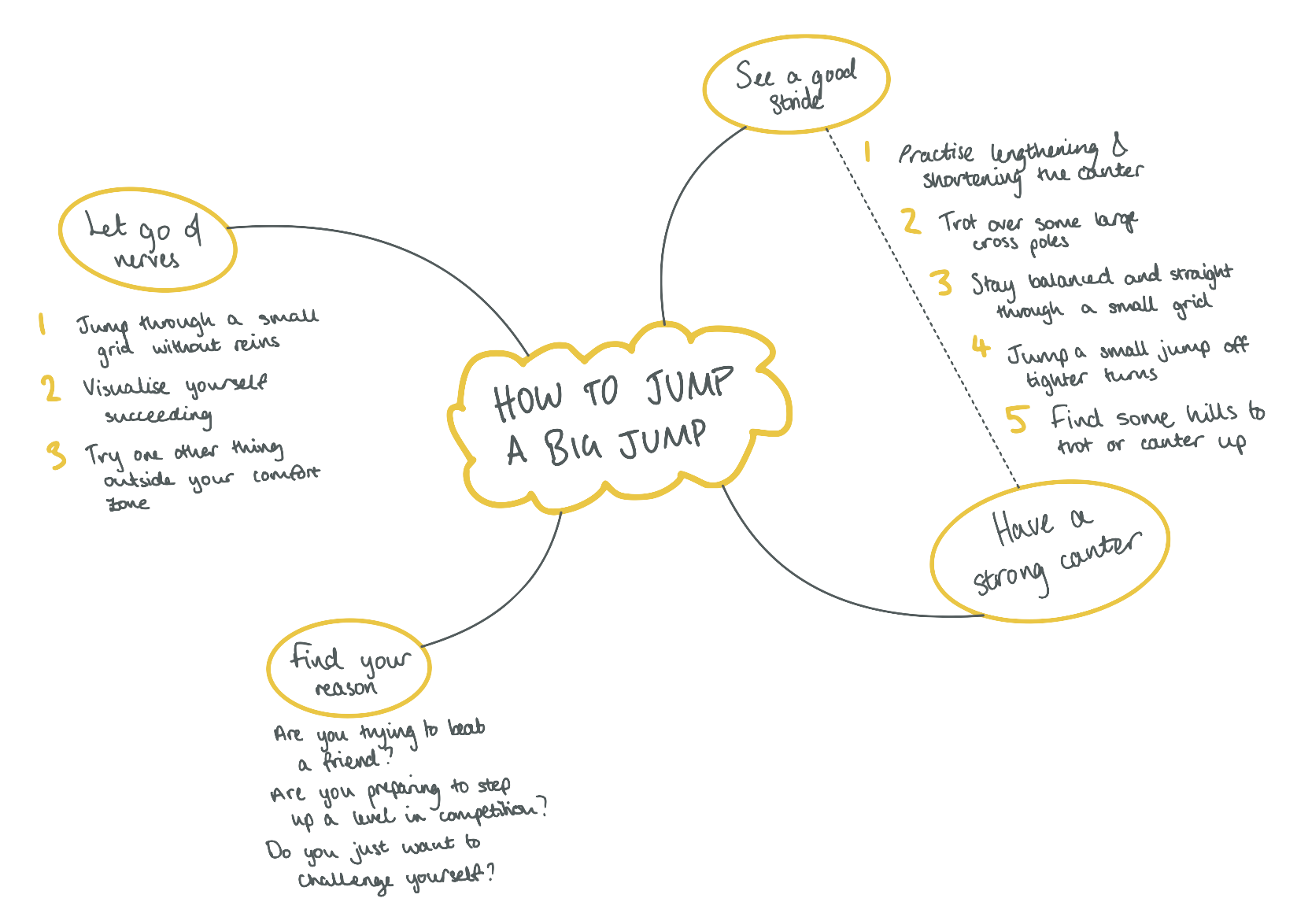
Once your big goal is broken down into clear, achievable steps, you’ll be ticking something off your list every day and feeling great about it. Each little bit of progress will become something to celebrate, and you’ll find your motivation skyrocketing each day as you find yourself and your horse improving with each ride.
Quit While You’re Ahead
Whether you’re a goal-setter or a play-it-by-ear person, an incredibly valuable trait to have is the ability to appreciate every small improvement. We’ve all heard it a hundred times – quality over quantity – and it really is true when it comes to training horses. When I’ve been schooling up horses, whether its weak youngsters or stiff older horses, I make it a rule to get off when they get it right. For instance, when I know I’m riding a horse who particularly struggles to find connection in canter, I’ll warm up and then spend a few minutes asking for a nice canter with a bit more bend and balance. Then, as soon as they offer me a nice stride or two, I drop my reins, walk around for a bit, and then get straight off. That way, this session has achieved two things: taught the horse the desired cue and response for a ‘nice’ canter, and learnt that hard work and correct answers earns a clear reward. Then the next session, even if it’s a whole week later, the horse will achieve this canter quicker, and for several more strides than before.
Sometimes this mindset will mean that you’re ‘quitting’ after only 5 or 10 minutes – and that’s fine! If your horse needs to keep moving for whatever reason, you can still change it up – walk over some poles, go for a short hack, or do some work in hand – but just be sure to take the pressure right off after your horse has correctly answered whatever challenging question you’ve been asking. Sometimes it’s tempting to try it just one more time, or just jump a little bigger, but remember, if this is has been a big ask for your horse, or a new skill, then it will have required a lot of both mental and physical energy, so sometimes trying again will result in a fatigued, frustrated horse not being able to give you what you’re asking for twice or thrice in a row. In rewarding even the smallest efforts, you will nurture a motivated horse with a great work ethic who wants to try their best for you.
Embrace the Setbacks
If you’re progressing, you’re going to have setbacks. That’s just part of the deal. I’m sure you’ve heard the phrase you have to crack the eggs to make the omelette, and if you haven’t, it sure is one to live by. In essence, things often get messy before they come together. For example, every time my OTTB makes a breakthrough with his trot work, our canter transitions fall apart a little while he adjusts to a new way of carrying himself and using his body through the transition. It can be frustrating, but each and every setback can be a learning opportunity if approached properly.
Next time you’re finding yourself struggling with a small setback, ask yourself why you might be experiencing it. Maybe your horse has started tapping the odd pole because his newly-improved jumping technique is harder work than before when he relied on momentum, or maybe you’re now struggling to keep your horse in an outline because he’s actually lifting his back and using his back end, and just needs a little time to adjust to this new correct way of going. Whatever it may be, just cut yourself some slack, appreciate the fab work you and your horse have been doing, and then re-approach your goal-setting with a fresh mindset.
Trust the Process
A mantra to live by. Include it in your daily affirmations. Get it tattooed on your forehead. Whatever it takes. Just remember that when things aren’t moving as quickly as you’d like, learning to love the process is the best thing you can do for both you and your horse’s progress. It makes every day feel just a bit more satisfying – even the ones where everything goes a bit wrong.
 Stuck in the Saddle